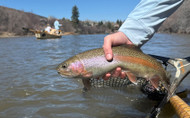
The Rainbow Warrior: One of the Best BWO Patterns
Take it from a guide that has spent countless days on the water with this pattern at the end of the line.
The Rainbow Warrior with a glass bead is an outstanding Blue Winged Olive (BWO) imitator because it doesn’t try to be a perfect copy—it imitates the triggers trout key on during the most vulnerable stage of the hatch.
Here’s why it works so well in detail:
1) It perfectly imitates the emerger stage
Most trout don’t feed heavily on the fully emerged adult BWO sitting on top. They feed on the nymphs rising through the water column and especially the emergers trapped in the film.
That is the exact zone where the Rainbow Warrior shines.
The slim body profile closely matches the torpedo-shaped Baetis nymph, which is the classic BWO form. Real BWO nymphs are narrow, sleek swimmers that drift naturally in the current.
As a guide, I’d say this is the #1 reason it outfishes more literal patterns on many days:
- it hangs in the feeding lane
- it resembles an ascending insect
- it suggests a bug in transition
Trout absolutely hammer that stage.
2) The glass bead mimics the gas bubble of emergence
This is the big one.
When a BWO nymph rises to hatch, it often traps tiny air bubbles or gases under its shuck. Those bubbles reflect light and create a subtle sparkle.
The glass bead on the Rainbow Warrior does this beautifully.
Instead of a harsh metallic flash, the bead gives a soft translucent glow, much like a real emergent mayfly.
To a trout looking upward through the water column, that bead can resemble:
- an air bubble
- a wing case beginning to split
- the bright thorax of an emerging Baetis
This is a major feeding trigger. Even attractor patterns like the Rainbow Warrior are often effective because they imitate that bubble effect.
A guide’s eye sees this immediately:
the bead is not just weight—it’s part of the imitation.
3) The flash body imitates light refraction, not literal color
Many anglers think BWOs must always be dull olive.
That’s true if trout are keyed strictly on naturals.
But underwater, insects do not always appear as matte olive. Light bends, flashes, and refracts off the bug’s body and shuck.
The Rainbow Warrior’s pearl and rainbow flash imitates:
- trapped gas
- reflective shuck material
- translucent wing pads
- light flashing off the natural insect
In moving current, trout often respond more to shine + size + silhouette than exact color.
As guides, we often say:
“Fish eat impressions, not photographs.”
The Rainbow Warrior nails the impression.
4) It matches BWO size extremely well
This is a huge factor that many anglers overlook.
Most BWOs are size 18–22, sometimes 16 depending on the river.
Rainbow Warriors are commonly tied in exactly those sizes.
When the profile and size match the hatch, trout are far more willing to eat a flashy attractor.
In fact, on technical rivers, I often find that:
- size matters more than color
- depth matters more than pattern
A size 20 Rainbow Warrior at the right depth often beats a perfect olive nymph drifting too high.
5) The red hotspot acts as a strike trigger
The red thread collar or hotspot gives trout a precise target.
Professional guides love flies with hotspots because trout frequently key on the thorax area of an emerger.
That red accent can suggest:
- exposed gills
- hemolymph / internal coloration
- the darker thorax of a hatching BWO
But more importantly, it gives fish something to focus on in fast current.
That translates into more committed eats.
6) It fishes exceptionally well in poor BWO weather
BWOs hatch best in:
- cloudy weather
- drizzle
- cold fronts
- low light
Those conditions reduce visibility underwater.
A slightly flashy fly becomes easier for trout to locate.
This is why guides often prefer Rainbow Warriors on overcast BWO days:
it’s easier for fish to see than a muted olive pheasant tail.
Guide’s honest opinion
If I were guiding a BWO hatch, I’d fish the Rainbow Warrior as:
- lead fly in a two-fly nymph rig
- dropper under a dry during emergences
- euro-nymph point fly in size 18–20
It works because it hits every major trout trigger:
size + slim profile + bubble effect + flash + hotspot + correct depth
That combination is deadly.
In guide terms:
It doesn’t imitate the exact bug—it imitates the moment trout most want to eat the bug.
And that’s why it works so incredibly well as a BWO imitator.